Used in High Strength Structural (Multi Story) Applications
2
5 MPA
5:1
Used in Normal Load Bearing Applications (Housing)
Major Benefits
Plastering & bricklaying teams are immediately productive from the time of delivery, resulting in a huge increase in productivity, as well as less mixing labour. An earlier completion of the wet trades and project is entirely feasible.
Superior quality: A far more homogenous mix that has been weigh batched eliminating inconsistent smaller batch mixing and associated variables.
By blending sands, cements and admixtures an optimum mix is achieved resulting in a more cohesive, workable product which results in less wastage.
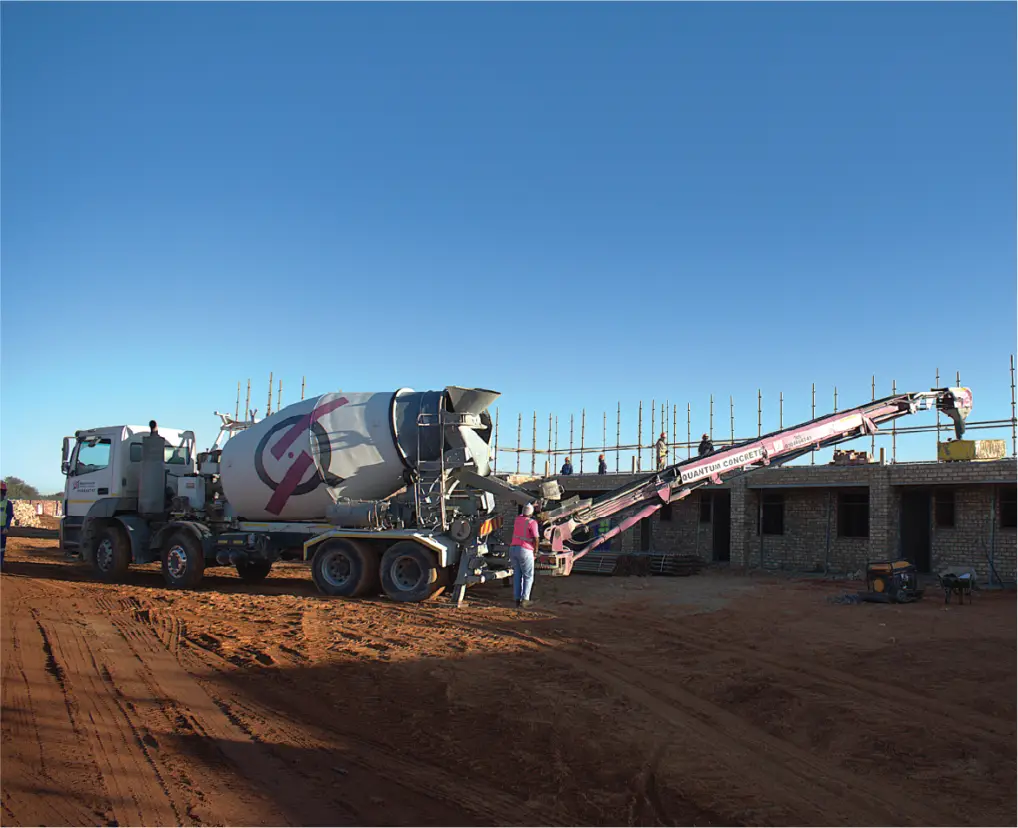
Use the truck mounted conveyor belt to deliver the mortar on to the 1st floor of buildings, enabling an immediate start up for the plastering teams on 1st and 2nd floors.
No storage of dry materials. Total footprint size is 5M X 5M for 6M? of mortar.
Quality assured, raw materials as well as the final product conforms to relevant specification.
Reduced cracking and remedial work due to conformity of the product.
Special mixes i.e. scratch plaster can be produced on request.
Less site administration and management.
No unsightly bags or disposal costs.
Raw materials, especially cement is far less prone to pilferage.
Schedule a late afternoon delivery of retarded mortar, for immediate use the next morning. (Don't forget to cover the mortar).
Product Use
The product is discharged into either mortar tubs or a pre-prepared DPC plastic lined dished area which has been set out on the ground as close to the working area as possible.
A dished area of 5M X 5M X 200 mm high brickwork can accommodate 6M3 of mortar. If the mortar is not being used or overnights, it should be covered with a thin plastic film so as not to dry out. Black plastic is more effective than translucent clear plastic as an insulator.
Shelf Life & Open Time
Standard mortar or plaster; Open time 7-9 hours depending on weather conditions.
Retarded mortars; Recommended is the retarded mortar of 12 hours to 18 hour retardation as this is the least susceptible to hot/cold weather conditions. Mortars can however be extended for as much as 24 to 36 hours on request.
PRE-WET BRICKS
Always pre-wet bricks before plastering or bricklaying, especially in dry weather.
SUN PROTECTION
Protect plaster from direct sunlight, especially on hot days. North facing walls are more prone to drying and cracking.
EXTRA DAGHA
Extra dagha must be accounted for when using bricks with cavities, as they require almost double the amount of dagha (as much as 175% more).
LIMIT EVAPORATION
Avoid placing dagha on absorbent surfaces like shutter boards to limit evaporation.
BRICKWORK ALIGNMENT
Ensure brickwork is perpendicular and flat to use the least amount of plaster possible.
WHEELBARROW VOLUME
A wheelbarrow holds 65 litres. Two pockets of cement fill one
MIX RATIO
Always pre-wet bricks before plastering or bricklaying, especially in dry weather.