



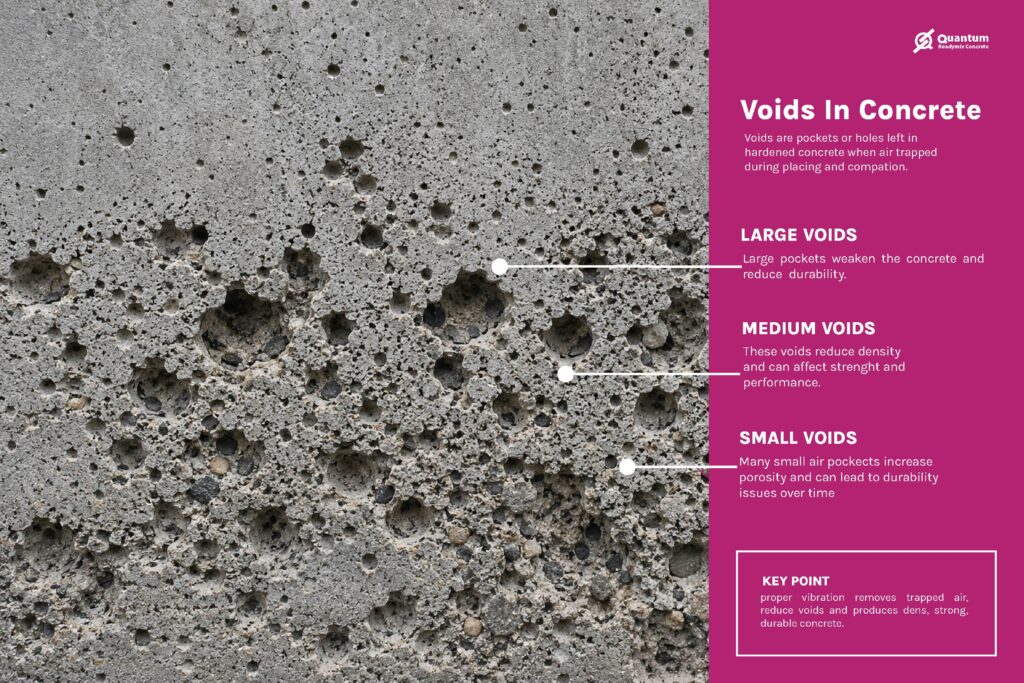
Air in concrete affects strength, density and durability. When fresh concrete is not properly compacted, entrapped air can remain in the mix and create air voids in concrete. Correct vibration helps remove these bubbles during placing, allowing the concrete to consolidate into a denser, stronger and more durable material.
What this guide covers
- Why air voids in concrete reduce strength and density
- How incomplete compaction creates porous concrete
- Why slump, water content and reinforcement affect trapped air
- How a concrete vibrator helps remove entrapped air
- How to use a concrete poker correctly on site
- When revibration may help under hot dry conditions
Why air voids in concrete matter
Air voids in concrete matter because excessive trapped air reduces density, strength, durability and abrasion resistance.
As little as 5% air can reduce the strength of concrete by as much as 20% or more. This is why vibration and compaction are not small site details. They directly affect whether the placed concrete can achieve its intended performance.
Concrete contains water and air, but neither contributes directly to physical strength. Water is needed for cement hydration, but too much water or too much trapped air can create a weaker, more porous concrete.
Excessive trapped air can affect concrete by:
- Reducing density
- Lowering compressive strength
- Increasing porosity
- Reducing durability
- Increasing shrinkage risk
- Reducing abrasion resistance in floors
- Creating visible voids in concrete
The goal is not to remove every microscopic air pocket. The goal is to prevent excessive entrapped air caused by poor placing, poor compaction or incorrect vibration.
How slump, water and reinforcement affect trapped air
Slump, water content and reinforcement all affect how easily concrete can consolidate and release trapped air.
Low slump concrete is stiffer and can trap more air if it is not compacted properly. Quantum’s Tip 1 notes that low slump concrete may entrap as much as 20% air. That trapped air becomes a problem when it remains inside the concrete after placing.
High slump concrete usually traps less air because it is more workable, but that does not make a very wet mix the better option. A wetter mix can increase evaporation, shrinkage and other handling risks, especially if water is added on site without proper control.
Heavy reinforcement also makes compaction more difficult. Steel slows the movement of concrete and can prevent the mix from settling under its own weight. This is why vibration around reinforcement needs to be planned and carried out carefully.
In practical terms:
- Stiffer concrete needs careful compaction.
- Wetter concrete creates shrinkage and segregation risks
- Reinforced sections need better poker access.
- Adding water is not a substitute for proper placing and vibration.
Why concrete vibration improves strength
A concrete vibrator improves strength by helping trapped air rise out of the concrete and allowing the mix to consolidate more densely.
Fresh concrete contains air bubbles after batching, delivery and placing. If those bubbles are not removed, the concrete hardens with unnecessary voids. Vibration temporarily loosens the fresh concrete so it can flow around aggregate, reinforcement and formwork while trapped air escapes.
Better vibration improves the degree of consolidation. Consolidation can affect compressive strength as much as the water-cement ratio. Quantum laboratory testing also shows a clear relationship between density and cube strength.
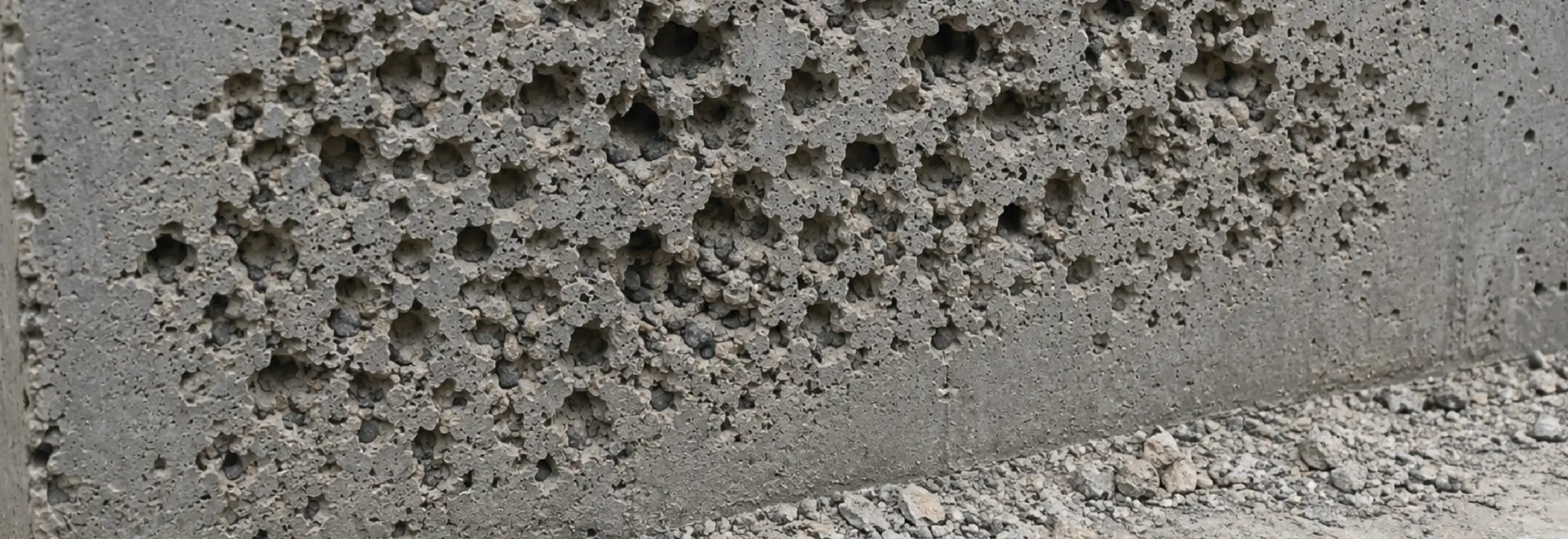
Poorly vibrated concrete is more likely to be porous. It may look rough, weak or open in some areas, especially where access was difficult or the poker did not reach properly.
Visible voids and poor consolidation can sometimes contribute to defects such as honeycomb concrete.
Good concrete poker practice on site
A concrete poker should be used in a consistent pattern, with the correct spacing, vibration time and slow withdrawal to remove trapped air without causing segregation.
A poker vibrator for concrete works by vibrating a local area around the poker head. A 50 mm poker has a radius of action of about 200 mm and can work about 5 m³ of concrete per hour. The poker diameter helps determine how close each insertion point should be.
The key is overlap. Each vibrated area should overlap the next so that no section is left unvibrated.
| Good vibration practice | Poor vibration practice |
|---|---|
| Use a systematic poker pattern | Vibrating randomly and missing sections |
| Space insertions so vibrated areas overlap | Leaving gaps between poker positions |
| Keep the poker vertical where possible | Dragging concrete sideways with the poker |
| Immerse the poker fully | Only vibrating the top layer |
| Withdraw the poker slowly | Pulling the poker out too quickly |
| Avoid touching the forms | Letting the poker knock the formwork |
| Vibrate until air bubbles are expelled | Stopping before air has escaped |
| Avoid excessive vibration | Vibrating so long that segregation occurs |
A vibrator for concrete compaction must be used for long enough to expel trapped air, but not so long that the concrete separates. If the poker is withdrawn too quickly, it can leave a poker void behind. If it touches the forms, it can damage the formwork or create poor edge quality.
Expert site tip
Watch the bubbles. Keep the poker immersed until the main air bubbles have been expelled, then withdraw it slowly and move to the next overlapping position. The goal is full consolidation, not over-vibration.
What is revibration and when can it help?
Revibration is the controlled re-vibration of plastic concrete within the correct time window to improve strength and help close early plastic shrinkage cracks.
Under hot, dry conditions, plastic shrinkage cracks may become visible before the concrete has fully hardened. Revibration of the plastic concrete can help both strength and the elimination of these cracks if carried out correctly.
Revibration is normally done within 1 to 2 hours of placing, while the concrete is still plastic enough to respond. It should not be treated as a general fix for poor placing or poor curing. It is a specific technique used when timing, site conditions and concrete condition allow it.
Revibration may help when:
- The concrete is still plastic
- Hot, dry conditions are increasing early shrinkage risk
- Plastic shrinkage cracks are becoming visible
- The team can revibrate without damaging the concrete surface
- The work is done within the correct time window
What is honeycombing in concrete?
Honeycombing in concrete is a visible defect caused by incomplete compaction, where trapped air leaves open pockets or exposed aggregate after the concrete has hardened.
Honeycombing is one possible result of excessive air voids in concrete, but it is not the only one. Poor consolidation can also reduce density, strength and durability even when voids are not immediately visible.
Using a concrete vibrator correctly helps remove entrapped air during placing, reducing the risk of honeycombing and improving the overall quality of the hardened concrete.
Quick answers to common air void questions
Can air voids in concrete be completely eliminated?
No. Small amounts of air are normal in fresh concrete. The aim is to remove excessive entrapped air through proper placing and compaction.
Which concrete elements are most difficult to compact?
Columns, beams, heavily reinforced walls and deep foundations are often the most difficult because trapped air cannot escape as easily.
Can air voids in concrete be seen from the surface?
Not always. Some voids in concrete are hidden inside the concrete and may only become visible after formwork is removed or during testing.
Is vibration always required?
Most reinforced concrete requires proper vibration to achieve good consolidation. The exception is self-compacting concrete, which is specifically designed to flow and consolidate without internal vibration.
Can the same concrete poker be used for every pour?
Not always. The poker diameter should suit the concrete element and the spacing of the reinforcement so it can reach all areas that need compaction.
Does adding more water remove trapped air?
No. Adding water is not a substitute for proper vibration. It may improve workability temporarily, but it can also affect the concrete’s strength and durability.
Can over-vibration damage concrete?
Yes. Excessive vibration can cause segregation, where the concrete materials separate instead of consolidating evenly.
One thing to remember
Concrete strength is not only affected by the mix design. Site compaction matters too. Correct vibration helps remove trapped air before voids in concrete are created, making the placed concrete denser, stronger and more durable.
Looking for more practical concrete guidance? Browse Quantum’s Technical Tips library.