
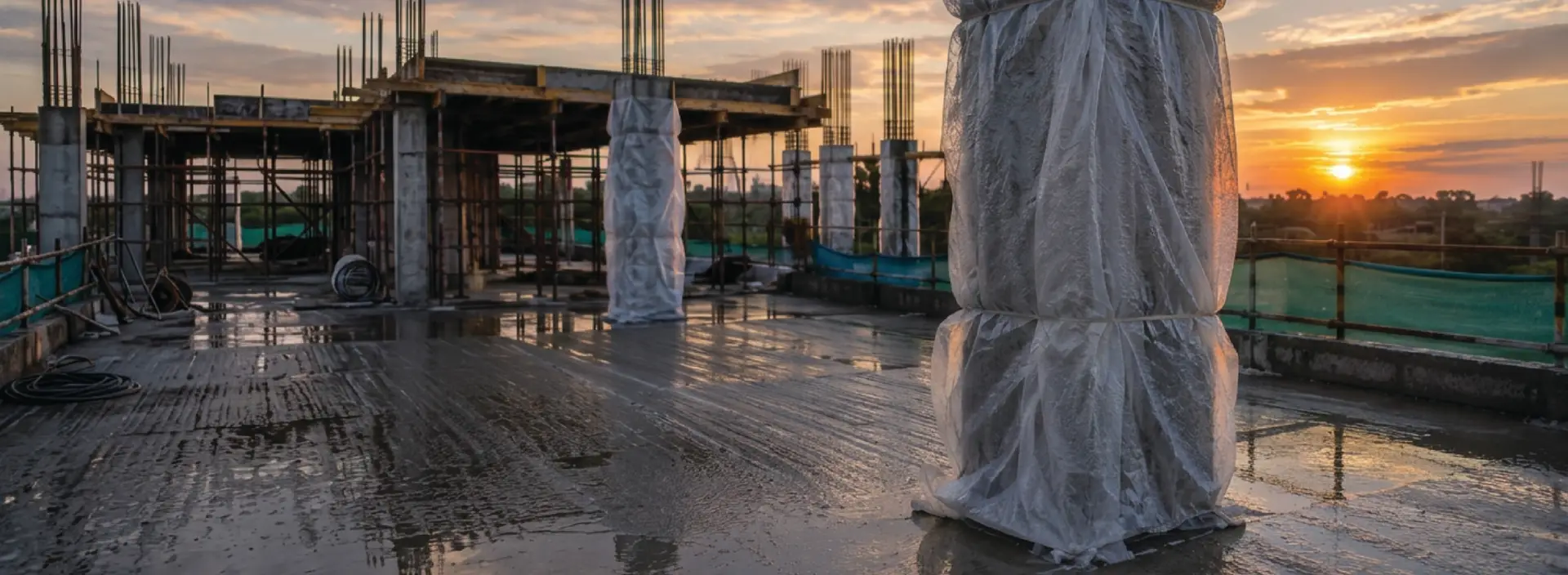






Curing of concrete protects fresh concrete from moisture loss while it gains strength. Correct curing, including the use of a good-quality concrete curing compound, helps reduce plastic shrinkage cracking, improve durability and protect the surface during hot, dry or windy site conditions.
What this guide covers
- Why curing of concrete is important for strength and durability
- How moisture loss can cause early-age cracking
- When a concrete curing compound should be used
- How weather affects curing and surface protection
- Correct spray coverage, distance and application rates
- Practical curing methods for columns, surface beds and suspended slabs
Why does curing of concrete matter?
When is concrete most at risk of drying out?
The curing of concrete matters because fresh concrete must retain enough moisture to gain strength and resist early cracking.
Concrete consists of roughly 20% water by volume. During the early stages after placing, moisture helps the cement hydration process continue while the concrete develops strength. If the concrete surface dries too quickly, it may shrink before it has enough strength to resist that movement.
This early moisture loss can lead to plastic shrinkage cracking. These cracks form when evaporation from the surface creates shrinkage stresses in fresh concrete that has not yet hardened enough to hold itself together.
Good curing helps reduce this risk by slowing moisture loss. It also supports better surface quality, durability and abrasion resistance, especially on exposed concrete floors and slabs.
This is why curing of concrete is important. It is not just an afterthought once placing and finishing are complete. It is part of the concrete performance process.
Concrete is most at risk of drying out when heat, low humidity and wind combine to pull moisture from the surface too quickly.
Hot, dry and windy conditions create the highest risk of rapid evaporation. In Gauteng, spring conditions can be particularly challenging because temperatures rise, humidity can be low and wind speeds can increase.
The risk becomes more serious when:
| Site Condition | Why It Increases Curing Risk |
|---|---|
| Temperature above 30°C | Speeds up evaporation from the surface. |
| Relative humidity below 60% | Allows moisture to leave the concrete more quickly. |
| Wind above 40 km/h | Removes surface moisture and can disrupt spray coverage. |
| Direct sun exposure | Heats the concrete surface and increases drying. |
| Dry subgrade | Draws moisture from concrete placed above it. |
This does not mean the article is only about hot weather concreting. The same curing principle applies in normal conditions too. The concrete must be protected from losing moisture too quickly while it is still gaining strength.
When pouring concrete in hot weather, site teams should plan curing before the concrete arrives. Waiting until concrete is poured, is too late.
How do curing compounds help protect concrete?
A concrete curing compound helps protect fresh concrete by forming a film that slows moisture loss from the surface.
Curing compounds are especially useful where continuous wet curing, ponding or covering is difficult to manage. They are commonly sprayed onto concrete after finishing, after formwork removal or as soon as the surface is ready for protection.
The quality of the compound matters. A curing compound should have good water-retention properties and should comply with recognised standards such as SANS 423 or ASTM C309 where relevant.

As a general guide:
- Resin-based curing compounds are usually preferred.
- Wax-based curing compounds can also be suitable.
- Acrylic compounds are generally less effective.
- White pigmented resin compounds are useful for pavements and external floors because they help reflect heat and show coverage.
- Unknown or cheap compounds can fail to provide proper moisture protection.
- Compounds older than 12 months should be treated with caution.
A curing compound only works if it forms a continuous film. If the product is poor quality, badly mixed, applied too thinly or sprayed unevenly, moisture can still escape through missed areas and pinholes.
How should curing compounds be applied on site?
The aim is complete, uniform coverage. A good product can still fail if it is applied incorrectly.
| Good Curing Compound Practice | Reason |
|---|---|
| Use a known-quality compound | Helps ensure reliable moisture retention and consistent performance. |
| Check the age and condition before use | Older compounds may separate or lose effectiveness during storage. |
| Mix or roll the drum before application | Ensures the active ingredients are evenly distributed before spraying. |
| Apply as soon as practical after finishing | Reduces early moisture loss while the concrete is most vulnerable. |
| Hold the nozzle 300 mm to 500 mm from the surface | Produces a more even spray pattern and better coverage. |
| Use a wind shield in windy conditions | Reduces spray drift and improves actual coverage. |
| Aim for uniform coverage | Prevents missed areas where moisture can escape. |
| Apply two coats at right angles where needed | Improves coverage and reduces the risk of pinholes. |
| Apply at approximately 2.5–5 m² per litre | Helps achieve the recommended film thickness for effective curing. |
| Clean nozzles and pipes after use | Maintains an even spray pattern and prevents equipment blockages. |
A hand-operated sprayer or power sprayer can be used, provided the pressure and spray pattern are suitable. On larger floor areas, a long spraying lance can help the applicator maintain better control and coverage.
Wind is one of the biggest site problems during application. It can blow the spray away from the intended area, which means the actual coverage may be far less than the theoretical coverage. In windy conditions, use a baffle or wind shield to reduce compound loss.
For effective coverage, typical application rates are between 2.5 m²/litre and 5 m²/litre. The exact rate depends on the product, site conditions and required coverage.
Expert site tip
A curing compound only works where it actually covers the concrete. Missed areas, pinholes and wind-blown spray can still allow moisture to escape, so coverage is just as important as product choice.
How should columns, surface beds and suspended slabs be cured?
Different concrete elements need different curing protection, but the goal is always the same: reduce moisture loss while the concrete gains strength.
Columns
For columns, the best protection is often to leave the shutters in place for as long as possible. If shutters are removed early, the columns should be wrapped in plastic sheeting or protected with a suitable curing compound.
Fresh vertical concrete should not be left exposed to sun and wind without protection.
Surface beds
For surface beds, the subgrade should be dampened before concreting starts. A dry subgrade can absorb moisture from the concrete.
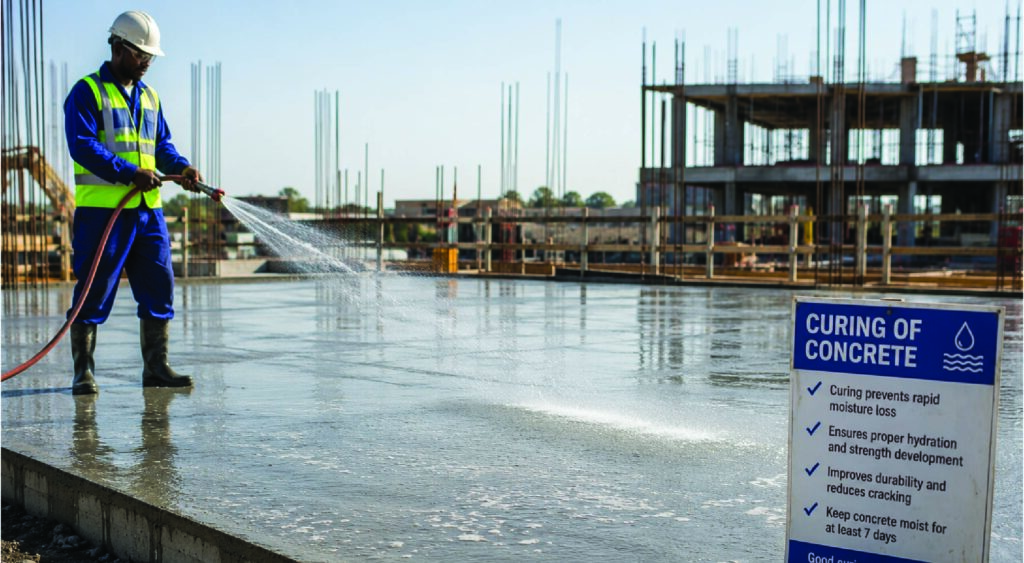
Where practical, ponding is one of the best curing of concrete methods for surface beds. This can be done by forming a small berm wall around the perimeter and holding water on the slab after it has been finished.
When curing concrete slab areas, the early protection period matters most. Poor curing can lead to cracks that may be 25 mm to 50 mm deep, and once the floor is trafficked, those cracks can quickly become visible stress signs.
Suspended slabs
Suspended slabs should receive the correct curing compound as soon as floating is complete. Exposed slabs can dry quickly, especially in wind or direct sunlight.
The same principle applies to concrete slab curing time. The exact duration depends on the concrete, weather and project requirements, but early protection must start as soon as practical.
Quick answers to common curing questions
Can you use water instead of a concrete curing compound?
Yes. Methods such as ponding, wet coverings and continuous water curing are effective, provided the concrete remains moist throughout the curing period. The best method depends on the type of concrete element and site conditions.
Does rain damage freshly applied curing compound?
Not necessarily. Once the curing compound has formed its protective film, light rain is usually not a problem. Heavy rain before the film has developed may reduce its effectiveness and require the area to be inspected.
Can curing compound be applied more than once?
Yes. If coverage is uneven or specified by the manufacturer, a second coat applied at right angles to the first can help achieve more uniform protection.
Does curing stop concrete from cracking?
No. Curing of concrete helps reduce the risk of early moisture-loss cracking, but it cannot prevent cracks caused by poor design, incorrect jointing, excessive loading or ground movement.
Can old concrete curing compound still be used?
Not always. Curing compounds should be checked before use, as older products may separate or lose effectiveness during storage. Always follow the manufacturer’s shelf-life recommendations.
Can wind affect curing compound application?
Yes. Strong wind can blow spray away from the concrete surface, resulting in uneven coverage. Using a wind shield or adjusting the spraying method helps achieve a more consistent protective film.
How long is concrete curing time?
Concrete curing time depends on the concrete, weather and project requirements, but early protection is most critical because moisture loss soon after placing can cause cracking and surface weakness.
One thing to remember
Good curing is not an optional extra after placing. The curing of concrete keeps valuable moisture in during the early strength-gain period, and a concrete curing compound only works when it is good quality, properly mixed and applied evenly across the surface.
Looking for more practical concrete guidance? Browse Quantum’s Technical Tips library.