



Fly ash concrete can keep gaining strength long after the normal 28-day test age. When good-quality fly ash is used correctly, it reacts with free lime, reduces water demand and helps produce denser, more durable concrete with stronger long-term performance.
What this guide covers
- What is fly ash in concrete and why it is used
- Why fly ash concrete can gain strength after 28 days
- How fly ash cement supports long-term performance
- The main advantages of fly ash in concrete
- Why fly ash reacts with free lime
- How lower water demand can improve density and shrinkage performance
- Why fly ash is useful in structural and water-retaining concrete
What is fly ash in concrete?
What is fly ash in concrete? Fly ash is a fine pozzolanic material used with cement to improve the long-term performance of concrete.
Fly ash is produced as a by-product when pulverised coal is burned in coal-fired power stations. In South Africa, much of the construction-grade fly ash supply is associated with Eskom’s pulverised coal-fired power stations, with commercial processing facilities linked to stations such as Lethabo, Kusile and Matla.
A pozzolan reacts with water and free lime produced during cement hydration. This reaction forms additional cementitious compounds inside the concrete. The result is not just a filler effect. When the fly ash is good quality and correctly used, it contributes to the hardened concrete’s strength, density and durability.
This matters because concrete is not finished developing at 28 days. The 28-day result is important for quality control, but it does not always show the full long-term strength potential of concrete containing fly ash.
The use of fly ash in South Africa has grown significantly since the mid-1970s. It has become widely accepted in structural concrete, high-strength concrete and water-retaining structures where long-term durability is important.
Why fly ash concrete keeps gaining strength
Fly ash concrete can continue gaining strength after 28 days because the fly ash reaction continues over time.
Most specifications focus on 28-day strength. That makes sense for standard testing and acceptance, but it does not tell the whole story where fly ash is used. The strength gain after 28 days can be substantial, depending on the curing conditions and the percentage of fly ash used.
The source table compares ordinary Cem I concrete with concrete containing 30% pulverised fly ash, expressed as a percentage of the 28-day strength.
| Cement system | 28-day strength | 56-day strength | 90-day strength | 365-day strength |
|---|---|---|---|---|
| Cem I (OPC) | 100% | 115% | 125% | 135% |
| Cem I + 30% PFA | 100% | 130% | 160% | 190% |
The findings are clear: the fly ash mix shows much stronger post-28-day strength development in this comparison.
At 365 days, the Cem I concrete is shown at 135% of its 28-day strength, while the Cem I plus 30% PFA concrete is shown at 190% of its 28-day strength. That is why judging fly ash concrete only at early age can miss the real performance benefit.
What the strength gain table means on site
The strength gain table matters because it changes how site teams should think about performance age.
A contractor may focus on early programme needs. A client may focus on specified strength. A supplier may be working with a mix designed for long-term durability. All three concerns are valid, but they are not the same question.
| Site question | What the fly ash data helps explain |
|---|---|
| Did the concrete reach its 28-day strength? | This remains an important quality-control point. |
| Will strength continue after 28 days? | Fly ash concrete can continue gaining significant strength. |
| Should the concrete be judged only by early-age behaviour? | No, later-age development may be part of the design benefit. |
| Does fly ash automatically mean weaker concrete? | No, there is strong long-term strength development. |
| Does curing still matter? | Yes, later strength gain depends on curing conditions. |
The decisive point is this: fly ash concrete should be judged according to the performance it was designed to deliver, not only by assumptions about early strength.
Why fly ash reacts with free lime
Fly ash improves concrete because it reacts with free lime and helps form additional cementitious compounds.
When cement hydrates, it produces free lime. Free lime is vulnerable because it can be leached out of the concrete over time. If that happens, voids may be left behind, and the concrete can become more vulnerable to water movement and durability problems.
Fly ash reacts with this free lime. The greater the proportion of suitable fly ash, the lower the available free lime. This helps improve the concrete matrix and supports a denser, more durable hardened concrete.
This is one of the key reasons fly ash cement and fly ash concrete can perform well in demanding applications. The benefit is not only strength gain. It is also the way the concrete becomes less permeable and better able to resist long-term deterioration.
Advantages of fly ash in concrete
The main advantages of fly ash are long-term strength gain, lower water demand, improved density, reduced free lime and better durability.
| Advantage | Why it matters |
|---|---|
| Lower water requirement for a given workability | Concrete can be denser and have less shrinkage potential. |
| Reaction with free lime | Concrete becomes more impervious and better able to resist chemical attack. |
| Ongoing strength development | Concrete can continue gaining strength well beyond 28 days. |
The water-demand point is especially useful on site. Concrete contains about 10% water. If a good-quality fly ash can reduce the water needed for a given workability, the result can be a better-quality concrete with improved density and durability.
This does not mean fly ash is a magic ingredient. It means the mix must be designed correctly, the fly ash must be suitable, and the concrete must be cured properly so the long-term reaction can continue.
How fly ash improves durability
Fly ash improves durability by helping produce denser, less permeable concrete.
Durability is not only about reaching a strength number. A concrete can meet its 28-day strength and still be vulnerable if it is too porous, allows water movement too easily or does not resist chemical attack well.
Good-quality fly ash can help produce concrete that is:
- denser
- more impervious
- less prone to shrinkage
- better able to withstand chemical attack
- stronger over the long term
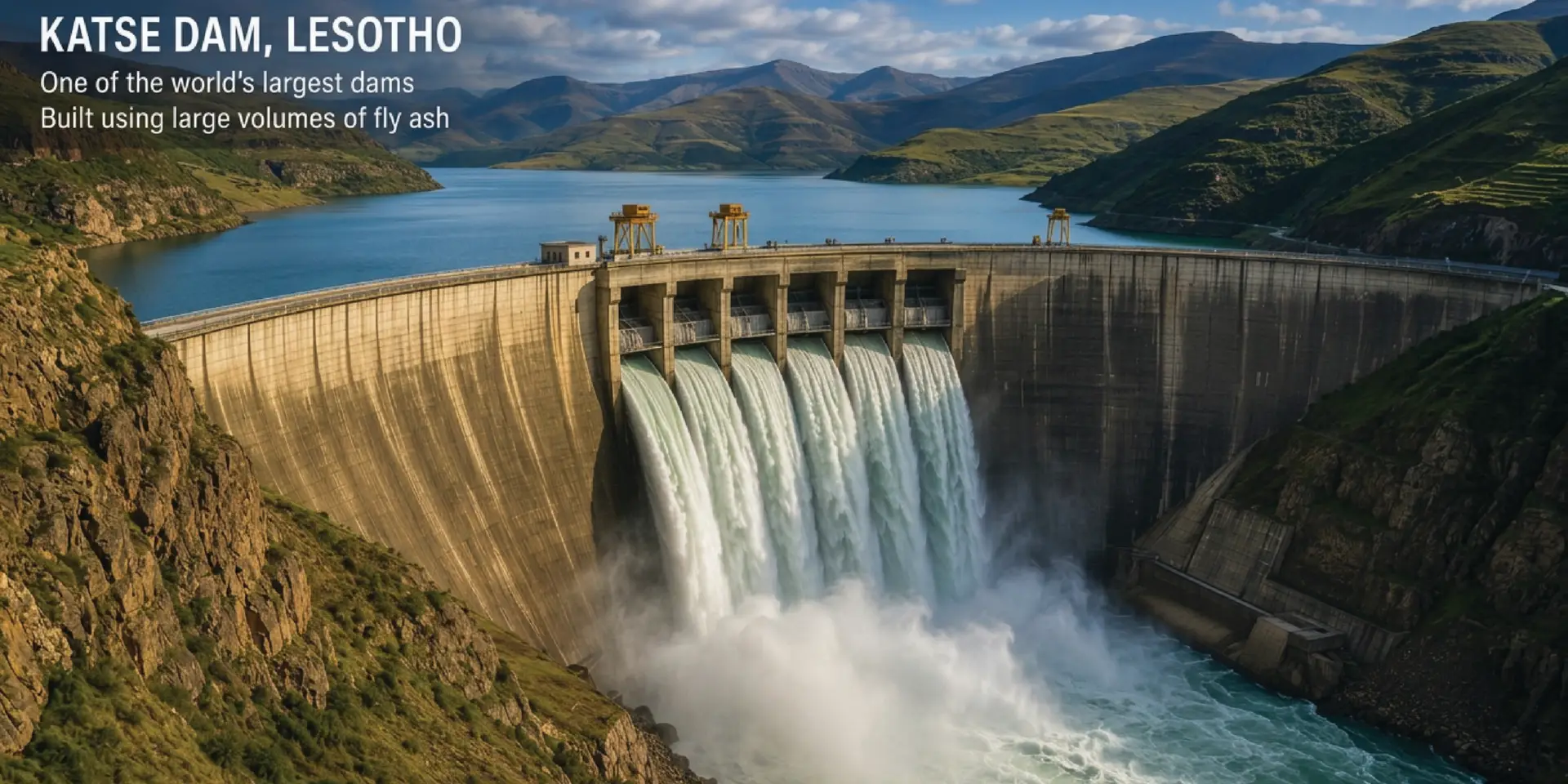
This is why fly ash is valuable in structural concrete, high-strength concrete, dams and water-retaining structures. The Tip refers to the Katemba-Maputo Bridge in Mozambique, where high humidity and coastal exposure made durability and reduced maintenance important considerations.
The findings are clear: in the right concrete, fly ash is used for performance, not just economy.
Where fly ash concrete is especially useful
Fly ash concrete is especially useful where long-term durability, lower heat of hydration and reduced permeability matter.
Structural concrete, high-strength concrete, dams, roller-compacted concrete and water-retaining structures as important examples. In these applications, long-term strength development and durability can matter as much as early-age strength.
| Application | Why fly ash can help |
|---|---|
| Structural concrete | Supports long-term strength gain and durability. |
| High-strength concrete | Can contribute to dense, durable concrete. |
| Dams and roller-compacted concrete | Lower heat of hydration can be useful in large concrete volumes. |
| Water-retaining structures | Reduced permeability supports durability. |
| Humid or chemically exposed environments | Denser concrete can improve resistance to deterioration. |
This section should not be read as a blanket rule that every project needs the same fly ash content. The mix design must match the structure, exposure, programme and performance requirements.
Are there different types of fly ash?
There are different types of fly ash, and their performance depends on the chemistry, quality and suitability of the material used.
The Tip itself does not become a classification guide. Its focus is the long-term performance of concrete containing fly ash. For that reason, terms like class f fly ash should be understood as technical classification terms, not the main topic of this article.
A practical way to think about it is:
| Topic | What site teams should know |
|---|---|
| Fly ash quality | Good-quality fly ash is needed for reliable performance |
| Fly ash content | The Tip’s strength table uses 30% PFA as the comparison |
| Fly ash type | Different materials can behave differently |
| Curing conditions | Later-age strength depends on continued reaction and moisture |
| Concrete application | Durability requirements should guide the mix design |
Do not assume all fly ash performs the same way. The concrete supplier or technical team should confirm whether the fly ash is suitable for the specific mix and application.
When fly ash is misunderstood
Fly ash is misunderstood when it is judged as a filler, a weakness or a short-term strength problem without considering the concrete’s design purpose.
The mistake is not simply “using fly ash”. The mistake is judging fly ash concrete using the wrong lens.
| Misunderstanding | Better interpretation |
|---|---|
| “Fly ash is just a filler” | It is a pozzolan that reacts with free lime and contributes to hardened concrete performance |
| “Fly ash concrete is weaker” | The Tip shows strong post-28-day strength development |
| Misunderstanding | Better interpretation |
|---|---|
| “Only 28-day strength matters” | Later-age strength can be important for long-term performance |
| “All fly ash performs the same” | Quality, chemistry, content and curing conditions matter |
| “Fly ash is only about cost” | Fly ash can affect strength, density, durability and reduced permeability |
When to ask about fly ash concrete performance
Ask about fly ash concrete performance when the project involves long-term durability, water retention, chemical exposure, large concrete volumes, lower heat of hydration or later-age strength requirements.
The right question is not only, “What is the 28-day strength?” It is, “What performance age and durability requirement is this mix designed to meet?”
This is especially important where the concrete will be used in structural elements, water-retaining structures, humid conditions, chemically aggressive environments or large pours where heat control matters.
Questions site teams ask about fly ash concrete
Does fly ash concrete get stronger after 28 days?
Yes. Fly ash concrete can continue gaining strength after 28 days because the fly ash reaction continues over time, especially when the concrete is properly cured.
Is fly ash just a filler in concrete?
No. Fly ash acts as a pozzolan. It reacts with water and free lime to form additional cementitious compounds that can improve the hardened concrete.
Is fly ash cement weaker than ordinary cement concrete?
Not necessarily. Fly ash cement may behave differently at early age, but the Tip shows strong later-age strength development where fly ash is used correctly.
What are the main advantages of fly ash?
The main advantages of fly ash are long-term strength gain, lower water demand, denser concrete, reduced free lime and improved durability against water movement and chemical attack.
Is class f fly ash the only type used in concrete?
No. Class f fly ash is one recognised category, but fly ash performance depends on chemistry, quality, suitability, mix design and curing conditions.
Related technical guides
One thing to remember
Fly ash concrete should not be judged only by early strength. Good-quality fly ash can reduce water demand, react with free lime, improve density and support long-term strength development, the real benefit is seen over time.
Looking for more practical concrete guidance? Browse Quantum’s Technical Tips library.