







A concrete cube test result should never be analyzed in isolation. A low result can come from the concrete, but it can also come from poor sampling, cube making, curing, added water, truck delays, batching variation or laboratory issues. The right response is not panic. It is a structured investigation.
Why a low cube result needs investigation
A concrete cube test failure does not automatically prove that the supplied concrete was defective.
That is the important starting point. When a cube result comes back below the required strength, the first reaction is often anxiety. The contractor worries about delays. The client worries about structural quality. The supplier worries about reputation. A cube result is extremely useful but only if the sample, cube-making, curing and testing process were reliable.
Before deciding what went wrong, check the entire process:
- Was the sample taken correctly?
- Were the cubes properly compacted?
- Were the moulds suitable and clean?
- Were the cubes protected from drying out?
- Was the curing tank temperature controlled?
- Was water added on site?
- Did the truck stand too long before discharge?
- Was the laboratory accredited for the test it performed?
- Are the results consistent across cubes, or is it one isolated result?
A compressive strength test of concrete gives useful evidence only when the process behind it is controlled. If one part of the chain is weak, the result can mislead everyone involved.
Concrete cube test troubleshooting checklist
A low cube result should be checked from several angles before a conclusion is reached.
| Possible cause | What to check | Why it matters |
|---|---|---|
| Curing tank temperature | Was the water kept between 22°C and 25°C? | Cold curing can slow strength gain and make a cube appear weaker than it should. |
| Unheated curing tank | Was the tank heated in winter? | A curing tank will be far colder than expected if the heater or thermostat is not working. |
| Tank power supply | Was the tank disconnected or disturbed? | A curing tank cannot do its job if it is switched off or unplugged. |
| Cube density | Does the cube weigh what it should? | A lighter cube may indicate poor compaction, trapped air or cube-making problems. |
| Plastic cube moulds | Were the moulds rigid, clean and properly handled? | Poor mould condition can affect cube shape, compaction and reliability. |
| Cube compaction | Were the cubes compacted correctly? | Poor compaction can reduce cube density and lower the test result. |
| Delayed curing | Were cubes left exposed before going into the tank? | Cubes that dry out before curing may not reflect the concrete's true potential. |
| Added water | Was water added and recorded on the docket? | Added water can affect strength and responsibility. |
| Truck standing time | How long did the truck stand before discharge? | Long delays can affect workability and quality, especially in hot weather. |
| Sampling method | Was the sample representative of the load? | A poor sample can make good concrete look bad. |
| Laboratory competence | Was the lab accredited for the specific concrete test? | Reliable results depend on the correct method, machine and laboratory competence. |
This checklist should be used as a basic guide, the SABS standards should be referred to for comprehensive processes and validation.
Cube curing and cube making can change the result
Cube curing and cube making can affect the result as much as the concrete itself.
The curing tank should be kept between 22°C and 25°C. If the water is too cold, strength gain slows down. The Tip notes that concrete ceases to gain strength below 5°C, and that an unheated curing tank in winter can easily sit around 10°C.
That matters because the cube may not fail because the concrete was wrong. It may fail because the cube was not given the right conditions to develop strength.
Good cube control includes:
- keeping the curing tank temperature controlled
- checking thermostats and heater elements
- making sure the tank is not disconnected for unrelated site use
- placing cubes into the curing tank at the correct time
- preventing cubes from drying out before curing
- using suitable cube moulds
- compacting cubes properly
- keeping clear records of cube age, storage and testing
The concrete cube making procedure also matters. If cubes are poorly compacted, they can trap air. That lowers density and may reduce the result, even if the concrete in the structure is not the cause of the issue.
A warning sign for 100 mm cubes: a cube that should weigh about 2.5 kg but weighs closer to 2.4 kg needs further investigation. This is not a replacement for formal testing, but it is a useful check when cube density is being questioned.
Cubes made before a weekend can also create problems. If they are only placed into the curing tank three or four days after casting, the early result may reflect poor cube handling rather than poor concrete.
Slump, added water and truck delays must be checked
Slump, added water and truck standing time can change the condition of the concrete before cubes are even made.
Ready-mix trucks are generally dispatched with a slump of around 75 mm to 100 mm. Once the truck reaches site, there is often pressure to make the concrete easier to place. The quickest temptation is to add water.
That is where disputes often start.
Added water may improve short-term workability, but it can affect the quality of the concrete. If water is added and not recorded on the delivery note or docket, the later test result becomes harder to interpret fairly.
The key site rule is simple:
- do not add water casually
- do not use water to fix poor site preparation
- record any added water on the docket
- understand that added water affects performance
Truck standing time is another risk. Concrete quality can begin to deteriorate after about 30 minutes where water is added to maintain slump, especially in summer. Long standing times of one to two hours create a much higher risk.
This matters because cubes may be made from concrete that has already been affected by delay, water addition or repeated adjustment. When that happens, a concrete strength test may reflect site handling as much as the original supplied concrete.
Raw materials and batching records belong in the investigation
Raw material and batching checks help determine whether the issue came from the concrete production process.
Concrete is made from materials that naturally vary. Sand, stone, cement, water and admixtures must all be controlled. If a cube result is low, the investigation should include the plant records, not only the site records.
Practical checks include:
- cement weighing records
- aggregate weighing records
- water weighing accuracy
- admixture dispenser condition
- possible admixture blockages
- batch records
- material source changes
- sand and aggregate consistency
Aggregate source changes affect performance, especially where quarries or pits are being rehabilitated near the end of their life. Material changes do not automatically explain a low cube result, but they should form part of the investigation.
If the cube result is disputed, the batch history must be checked alongside the site and laboratory process.
The SANS standards and lab accreditation checks that matter
A cube result is only as reliable as the method and laboratory behind it.
In South Africa, cube testing should be checked against the relevant SANS test methods for sampling, cube making, slump or consistence testing, curing and compressive strength testing. The exact standard references should always be confirmed against the project specification and the current SABS/SANS documents, but the standards most relevant to this article are:
| Standard or authority | Where it fits | Why it matters |
|---|---|---|
| SANS 5861 | Making and curing concrete cube specimens | Relevant when checking moulds, cube making, compaction and curing conditions. |
| SANS 5862 Part 1:2006 | Slump / consistence testing | Relevant when slump control and site water addition form part of the dispute. |
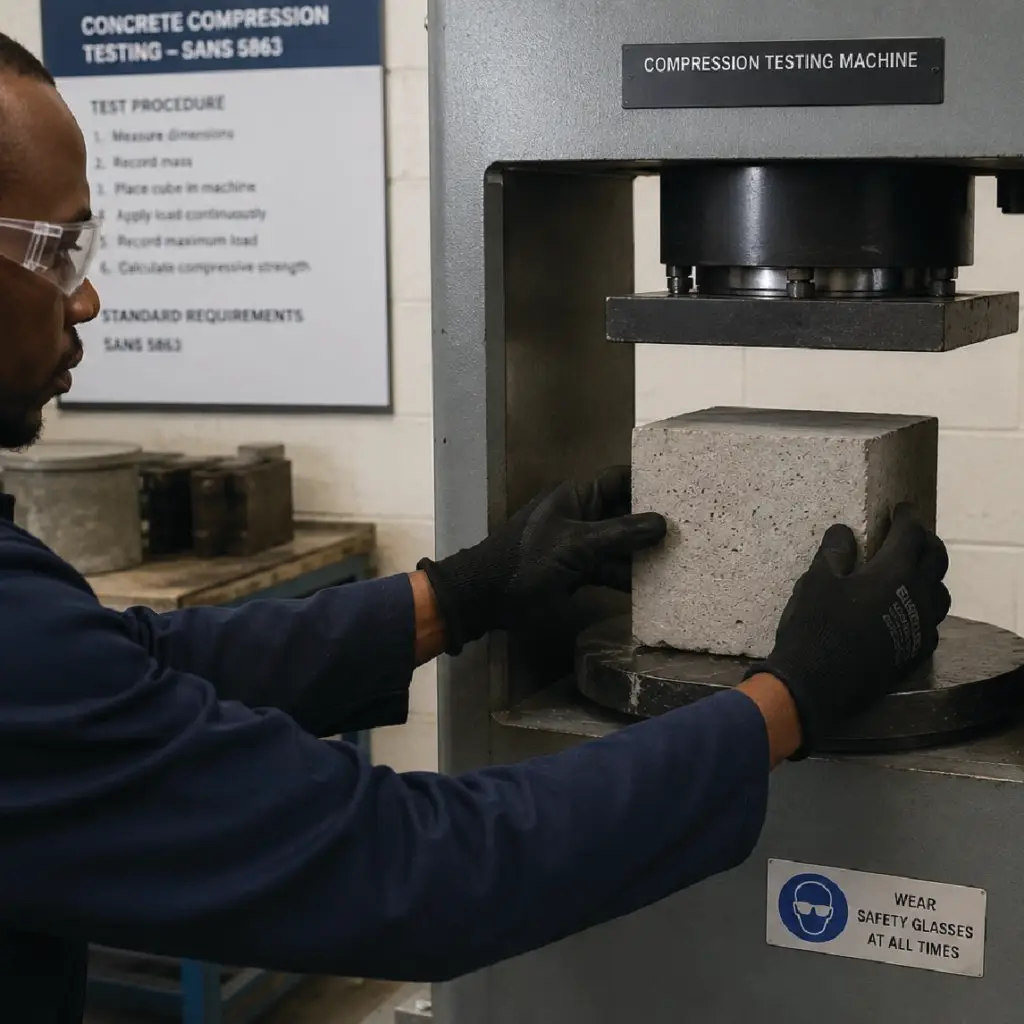
| SANS 5863 | Compressive strength testing | Relevant when reviewing how the cube was crushed and how the result was reported. |
| SANS 50197 / NRCS cement compliance | Cement conformity, if questioned | Relevant only if the investigation points to cement compliance or cement quality concerns. |
The practical question is not, “Was a test done?” The better question is, “Was the right test done, on the right sample, by the right laboratory, within the right scope?”
A laboratory should be SANAS-accredited for the specific concrete or aggregate tests required. A general testing laboratory, a soils laboratory or a bitumen laboratory should not be assumed suitable unless its scope of accreditation covers the concrete testing being relied on.
NRCS-related cement compliance may be relevant if the investigation points to cement conformity. But it should not be confused with the concrete cube test procedure itself. For a low cube result, the first checks remain sampling, cube making, curing, compressive strength testing and laboratory competence.
Sampling is where many disputes begin
A concrete cube test procedure depends on a representative sample.
A sample taken from a wheelbarrow is not a reliable representation of the full truck load. The same applies to a sample taken from a slow discharge, a partially discharged load or concrete that has already been affected by long standing time or added water.
A reliable mixer-truck sample should:
- be taken during discharge
- include at least nine increments
- take increments at equally spaced intervals
- avoid the first 10% of the truck contents
- avoid the last 10% of the truck contents
- take scoopfuls from the moving stream
- avoid concrete freefall greater than 500 mm
- be handled consistently after sampling
Expert site tip
Do not make cubes in a rush from a single sample. Make them from a representative incremental sample. The best sample tells the truth about the load. A convenient sample often tells the story of one wheelbarrow, one delay or one badly handled portion of concrete.
This is also where psychology matters on site. When a team is under pressure, convenience starts to look reasonable. But if the cube result later fails, that convenient shortcut can cost everyone time, money and trust.
Core results need careful interpretation
A carefully interpreted concrete core sample may be useful when cube results are disputed.
Cores are not simply “better cubes”. They are taken from hardened concrete, often after the structure has already been placed, cured and exposed to real site conditions. The result can be affected by location, extraction, curing, testing method and the condition of the in-situ concrete.
If cores are drilled, cured and tested, the interpretation should be made by a competent senior technician or suitably qualified technical person. Under the relevant SABS/SANS core-testing context referenced in the source guidance, a core result may be deemed acceptable if it is within 80% of the specified strength.
That does not mean a low cube result can be ignored. It means the full route must be understood. A core result can help resolve the question, but won’t replace a systematic investigation.
How to protect the result before there is a dispute
The best cube result is one that can be defended from sample to test.
If a low result comes back later, the paperwork and site records need to show what actually happened. That means the site team should record the key facts while the concrete is being placed, not after the dispute starts.
Useful records include:
- truck arrival time
- start and finish of discharge
- slump or workability observations
- any water added on site
- who approved the water addition
- cube casting time
- cube identification numbers
- where the sample was taken
- when cubes were moved to curing
- curing tank temperature records
- the laboratory used
- the lab’s SANAS scope, where relevant
When the evidence chain is clear, a low concrete cube test result can be investigated fairly instead of turning into guesswork.
Questions site teams ask when a cube result is low
Does one failed cube mean the concrete has failed?
No. One failed cube should be investigated together with the sampling method, cube making, curing conditions, site records and other test results before any conclusion is reached.
What standards apply to concrete cube testing in South Africa?
Concrete cube testing should be checked against the relevant SANS methods for sampling, cube making and curing, slump or consistence testing, and compressive strength testing. The commonly referenced standard terms include **sans 5861** for cube making and curing and **sans 5863** for compressive strength testing. The project specification and current SABS/SANS documents should always be used for final confirmation.
Why can a 7-day result cause unnecessary concern?
A 7-day result is an early indicator, not the final strength result. It can be useful for spotting a possible problem, but it should be reviewed with the cube history, curing conditions and the expected 28-day strength development before conclusions are drawn.
Should cube results from different labs be compared directly?
Cube results from different laboratories should be compared carefully. Testing machines, procedures, accreditation scope and sample handling can all influence reliability. If results differ, the laboratory process and competence should be reviewed before treating one result as the final answer.
One thing to remember
A low concrete cube test result is not the end of the investigation. It is the start of one.
Cube curing, cube making, added water, truck delays, sampling, batching records, SANS test methods and laboratory accreditation all need to be checked before concluding that the concrete itself failed.
Looking for more practical concrete guidance? Browse Quantum’s Technical Tips library.