
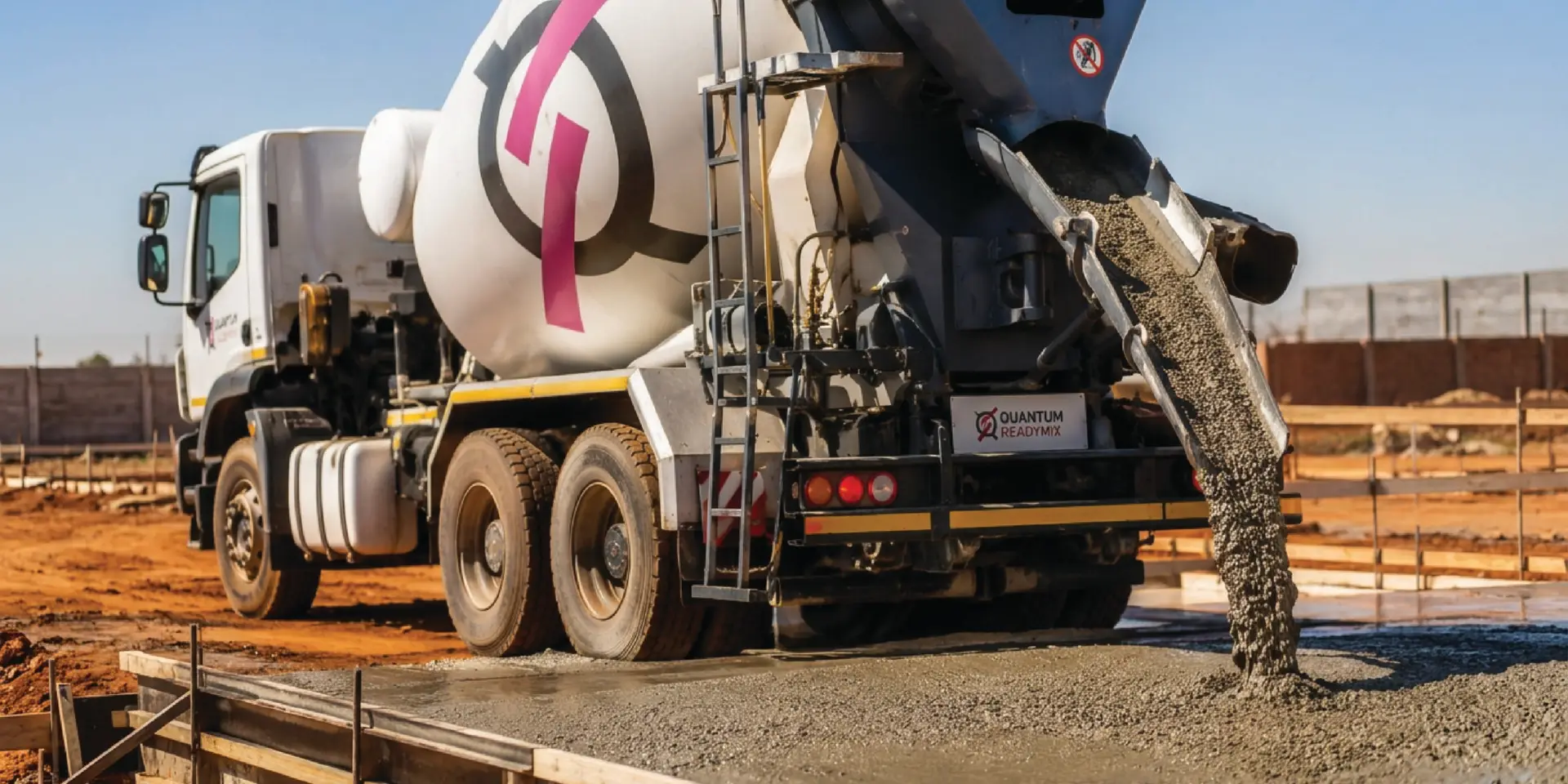






Concrete setting time can be delayed by cold weather, admixtures, extenders, cement chemistry and water quality. Slow setting is alarming on site, especially when ready mix concrete setting time does not match what the team expected the next day, but delayed set and final strength are not the same thing. The correct response is to investigate.
What this guide covers
- Why concrete setting time can be delayed
- What ready mix concrete setting time means on site
- How a concrete retarder affects fresh concrete
- What a retarder in concrete mix does when dosage is too high
- Why a concrete admixture must be controlled carefully
- How types of admixtures in concrete can affect setting behaviour
- Why setting time and 28-day strength must be interpreted separately
Why concrete setting time can be delayed
Concrete setting time can be delayed when the normal stiffening and hardening process is slowed by temperature, admixtures, extenders, cement chemistry or water quality.
On site, slow setting creates immediate pressure. The contractor worries about programme delays. The client worries that the concrete is defective. The supplier needs the actual cause understood before anyone makes a costly decision. When concrete has not set by the next day, the concern is valid, but panic is not a technical assessment.
When final set is around 10 hours or longer, concern is understandable. The important point is that slow setting should trigger investigation, not immediate removal.
Common causes include:
| Possible cause | Where it fits | Why it matters |
|---|---|---|
| Cold weather | More common in winter | Low temperatures slow hydration and setting |
| Temperatures below 5°C and dropping | High-risk placing condition | The Tip warns that concrete generally should not be placed under these conditions |
| Extenders such as fly ash or MGBS | Mix design and binder system | Cement class, gypsum content and extender type can affect setting |
| Admixture overdose | Fresh concrete behaviour | Too much admixture can severely delay setting |
| Water quality | Mixing water source | Municipal, borehole, recycled or contaminated water can affect consistency and set |
| Cement chemistry | Cement source and gypsum content | Gypsum content, normally around 3% to 5%, is part of set control |
The first decision is not whether to remove the concrete. The first decision is to identify which factor most likely delayed the set.
What is admixture in concrete?
What is admixture in concrete? It is a controlled material added to concrete to change how the mix behaves in its fresh or hardened state.
A concrete admixture is not automatically a problem. Admixtures are widely used in ready-mix concrete because they help control workability, water demand, setting, placing and performance. Modern ready-mix concrete would be difficult to produce consistently without them.
There are different types of admixtures in concrete, including admixtures that improve workability, reduce water demand, accelerate set, retard set or adjust other performance properties. This article focuses only on admixtures that affect setting time, especially retarders and overdosing.
A concrete retarder is used to slow the setting process. This can be useful when concrete needs more time for transport, placing or finishing. The risk comes when the retarding effect is stronger than expected or when the admixture is overdosed.
A retarder in concrete mix should be treated as a set-control tool. The dosage, cement chemistry, temperature, extenders and site conditions determine whether it performs as intended.
Why retarders and overdosing can cause slow setting
A concrete retarder slows the chemical reactions that allow concrete to stiffen and set.
Used correctly, this delay can be useful. Used incorrectly, or dosed too heavily, it can leave concrete plastic for much longer than expected. Admixture overdose is often visible and may even be detectable by the distinctive smell of the admixture.
The source trial looked at a 30 MPa concrete mix using 30% fly ash with Cem II 42.5 cement and increasing dosages of Chryso 122 admixture. The recommended dosage range was approximately 0.3% to 0.7%, but the trial included dosages up to 4%.
| Mix | Admixture dosage | Slump or behaviour | 28-day strength | What it shows |
|---|---|---|---|---|
| 01 | 0.5% | 60 mm slump | 39.5 MPa | Normal behaviour in the recommended range |
| 02 | 1.0% | 130 mm slump | 40.0 MPa | Higher slump, but 28-day strength still strong |
| 03 | 2.0% | Collapse slump | 37.0 MPa | Overdose affected workability, but 28-day strength remained acceptable |
| 04 | 3.0% | Flow, approximately 565 mm | 37.0 MPa | Concrete was not sufficiently set at 3 days, but later strength recovered |
| 05 | 4.0% | Segregation | 31.5 MPa | Severe overdose caused major early problems, but strength continued improving later |
Slow setting and later strength must be interpreted separately. In the trial, even grossly overdosed concrete showed later strength recovery, especially at 56 and 90 days.
If concrete has been severely retarded, the site may still face real problems: delays, finishing difficulty, shrinkage concerns, delayed cube stripping and uncertainty about when follow-on work can continue.
The correct question is not only, “Will it eventually gain strength?” The better question is, “Can the site tolerate the setting delay, shrinkage risk and programme impact while strength development is confirmed?”
Setting time and 28-day strength are not the same thing
Slow concrete setting time does not automatically mean poor 28-day strength.
This is the most important technical point Setting time tells you how long concrete remains plastic before it stiffens and hardens. Strength testing tells you how the hardened concrete performs at a specific age.
They are related, but they are not the same result.
| Site observation | What it tells you | What it does not prove |
|---|---|---|
| Concrete is still soft after expected set time | Setting is delayed | It does not automatically prove 28-day failure |
| Concrete has set normally | The set appears normal | It does not guarantee 28-day strength |
| Cubes cannot be stripped early | Early set or early strength may be delayed | It does not always predict final strength |
| Later strengths improve | Strength development is continuing | It does not remove all shrinkage or programme concerns |
| Concrete smells strongly of admixture | Overdose may be a possible cause | It still needs evidence and technical review |
This distinction matters because removing slow-setting concrete too early can be expensive and unnecessary. Removing even a small volume of hardened concrete can become a major cost.
The practical message is simple: do not judge concrete only by how it looks the next morning. Review the cause, records and strength development before deciding whether removal is necessary.
When slow setting becomes a site decision
Slow setting becomes a site decision when the delay affects stripping, finishing, loading, protection or programme.
This is the unique negative paradigm: do not treat slow-setting concrete as either “definitely failed” or “definitely fine”. Both assumptions can be wrong.
| Site reaction | Why it is risky | Better decision |
|---|---|---|
| Remove it immediately | Slow set does not automatically prove strength failure | Investigate cause and strength development first |
| Ignore it completely | Severe retardation can create shrinkage and programme risk | Monitor, protect and test appropriately |
| Blame fly ash only | Set is linked to several factors, not one ingredient | Review cement, extenders, admixture, water and temperature |
| Assume normal timing applies | Delayed set changes site sequence | Adjust stripping, finishing and follow-on work |
| Rely only on appearance | Surface condition can mislead | Use records, cube results and technical review |
What to check when concrete is not setting
When concrete is not setting as expected, check the site conditions, mix information, delivery records and early strength evidence before deciding what to do.
| Check | Why it matters |
|---|---|
| Placing time | Establishes how long the concrete has been setting |
| Ambient and overnight temperature | Cold weather can delay set significantly |
| Temperature below 5°C and dropping | Indicates a high-risk placing condition |
| Admixture type and dosage | Overdose is one of the clearest causes of retardation |
| Slump, flow or segregation | Abnormal fresh behaviour can support an overdose investigation |
| Cement type and gypsum content | Cement chemistry influences setting behaviour |
| Extenders in the mix | Fly ash and MGBS can affect set and strength development |
| Water source and quality | Contaminated or variable water can influence setting |
| Cube stripping and test results | Early strength may be delayed, but later strength may recover |
| Shrinkage risk | Severe retardation can increase drying shrinkage concerns |
| Technical review | A competent assessment should guide removal or acceptance decisions |
Expert site tip
If concrete has not set when expected, record the facts before making a decision. Note the placing time, temperature, slump behaviour, water source, admixture details and cube results. Slow set is a technical issue to investigate, not a reason to guess.
Questions site teams ask after slow setting
What is normal ready mix concrete setting time?
There is no single fixed setting time for every mix and every site condition. As a practical yardstick, Tip 4 refers to final set around 10 hours as a point where concern becomes valid, but temperature, admixtures, cement type, extenders and water quality all affect the result.
Can a concrete retarder make concrete fail?
A concrete retarder does not automatically make concrete fail. It can delay set, especially if overdosed, but strength development must be assessed separately. Severe overdosing can still create programme, shrinkage and quality risks.
What should be done if concrete has not set by the next day?
Do not remove it automatically. Record the conditions, review the mix and batch details, check for admixture overdose or cold weather, protect the concrete and get technical input before deciding what happens next.
Can slow-setting concrete still reach strength later?
Yes. Tip 4 shows that even severely retarded concrete may continue gaining strength at 56 and 90 days. That does not remove all site risk, but it proves that setting delay and final strength are separate issues.
When should removal be considered?
Removal should only be considered after the likely cause, site records, strength development, shrinkage risk and programme impact have been reviewed. If the concrete is removed too early, the site may be solving the wrong problem at high cost.
Related technical guides
One thing to remember
Slow setting is not the same as failed concrete. Concrete setting time can be delayed several factors. The safest response is to investigate the cause, review the evidence and confirm strength development before deciding whether the concrete must be removed.
Looking for more practical concrete guidance? Browse Quantum’s Technical Tips library.