
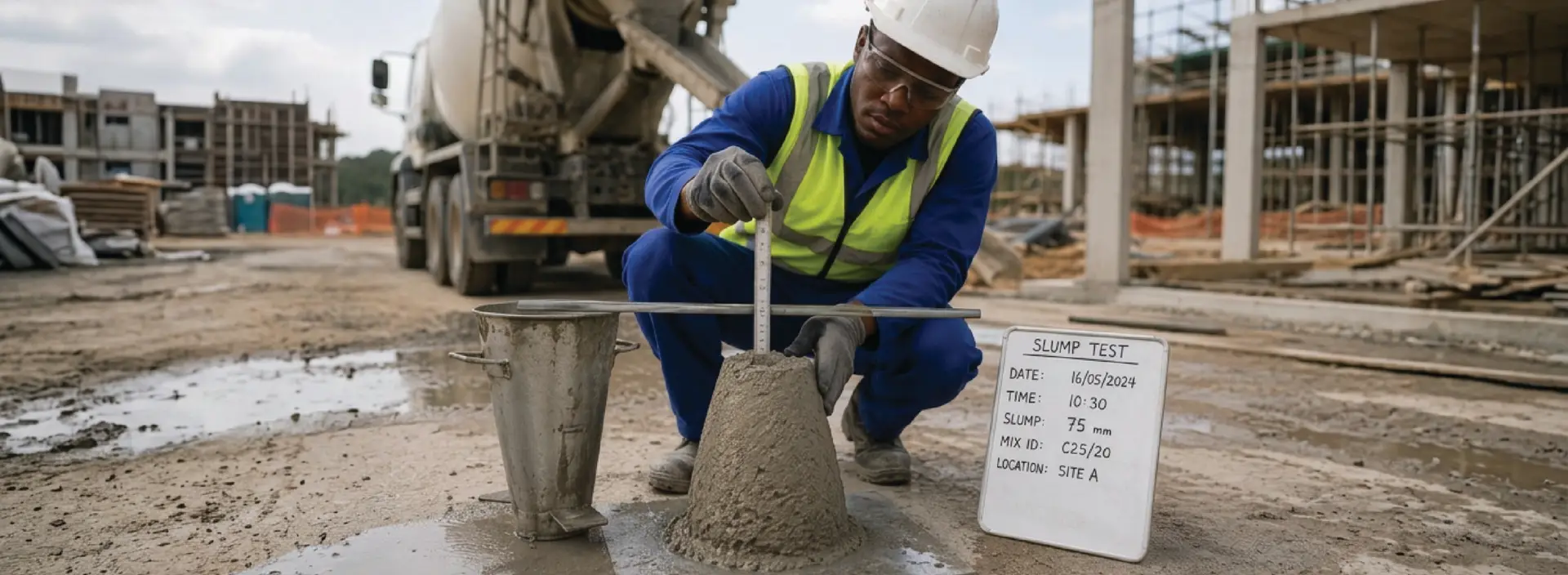




Concrete slump tells the site team how workable fresh concrete is when it arrives. That matters because concrete must be placed and compacted while it is still workable. When a truck stands too long, slump reduces. Adding water may restore workability for a short time, but it can reduce strength and create responsibility issues.
What this guide covers
- What concrete slump means on site
- How the workability of concrete changes while a truck stands
- What concrete slump range applies to standard and pump mixes
- Why adding water can reduce strength
- Why too much water in concrete creates quality and responsibility risk
- What to check before water is authorised on site
What concrete slump means on site
Slump meaning in concrete refers to the measured consistency of fresh concrete and how workable it is for placing and compaction.
A slump result does not measure strength directly. It tells the site team whether the concrete is too stiff, within the expected range, or too wet for the supplied mix.
The workability of concrete matters because concrete must move into place, flow around reinforcement and compact properly. If it is too stiff, placing becomes difficult. If it is made too wet by adding water, the concrete may become easier to move but weaker in service.
Quantum’s standard concrete is designed around a consistency of approximately 90 mm, with a concrete slump tolerance of plus or minus 25 mm. Pump mixes are designed for a higher workability of around 100 mm to 125 mm.
That means the correct concrete slump range depends on the mix and the placing method. A standard mix and a pump mix should not be judged as if they are the same product.
What a slump test actually checks
What is a slump test in concrete? It is a simple site test used to check the consistency and workability of fresh concrete before placing.
The concrete slump test is useful when concrete appears too stiff, too wet, or has been standing on site for longer than planned. It helps confirm whether the concrete is still within the expected workability range.
The critical detail is timing. The quoted workability applies to concrete on arrival on site. Once the truck stands, the concrete starts losing workability. A slump complaint should therefore be considered together with:
- arrival time
- standing time
- weather conditions
- placing method
- site readiness
- any water added on site
A slump result is useful evidence, but it is not the full investigation unless the site conditions are known.
Why concrete slump reduces when trucks stand
Concrete slump reduces because fresh concrete loses workability over time.
This is the real pressure point on site. The truck arrives. The team may not be fully ready. Access may be slower than expected. Labour, wheelbarrows, pump lines or vibration equipment may still be getting sorted. As the truck stands, the concrete stiffens and adding water starts to look like the fastest solution.
Under Highveld autumn conditions, standing time can cause major slump loss. The longer the concrete stands, the more water is needed to bring the slump back to the 75 mm to 100 mm range, and the greater the likely strength reduction.
| Time standing on site | Approximate slump loss | Water needed to maintain 75 mm to 100 mm slump | Approximate strength loss |
|---|---|---|---|
| 30 minutes | 35% | 8 litres/m³ | 5% |
| 60 minutes | 50% | 10 litres/m³ | 10% |
| 90 minutes | 60% | 12 litres/m³ | 15% |
| 120 minutes | 70% | 17 litres/m³ | 20% |
These estimates are conservative. Summer conditions, adverse weather and fine aggregate type can increase slump loss even further.
The decisive point is this: site readiness protects concrete quality. Labour, access, equipment, pump arrangements and placing routes should be ready before the truck arrives.
What happens when water is added to restore slump
Adding water increases slump, but reduces concrete strength.
Based on 25 MPa concrete at a 90 mm slump, there is a clear trade-off: as water is added, slump increases, but strength reduces.
| Water added | Approximate slump effect | Approximate strength reduction |
|---|---|---|
| 0 litres/m³ | 75 mm to 100 mm slump | 0% |
| +10 litres/m³ | About 120 mm slump | 10% |
| +20 litres/m³ | About 180 mm slump | 20% |
| +30 litres/m³ | Collapse slump | About 30% to 40% |
A moderate water addition may make concrete easier to place. A larger addition can push the mix into high slump concrete or collapse slump territory, where the concrete becomes too wet and the strength reduction becomes more serious.
For a site team under pressure, the decision is critical:
| Site decision | Short-term effect | Risk |
|---|---|---|
| Add water | Concrete becomes easier to place | Strength and responsibility may be affected |
| Place stiffer concrete | No added-water issue | Poor compaction risk increases |
| Delay further | Gives the team time | Slump loss continues |
| Reject or dump the load | Avoids uncertain placing | Cost and programme pressure increase |
| Authorise and record water | Creates a clear decision trail | The site accepts the change in workability and risk |
This is the control point. If a higher-than-design slump is required, the responsible person on site must authorise the water addition and it must be recorded on the delivery note or docket.
Why too much water creates a quality risk
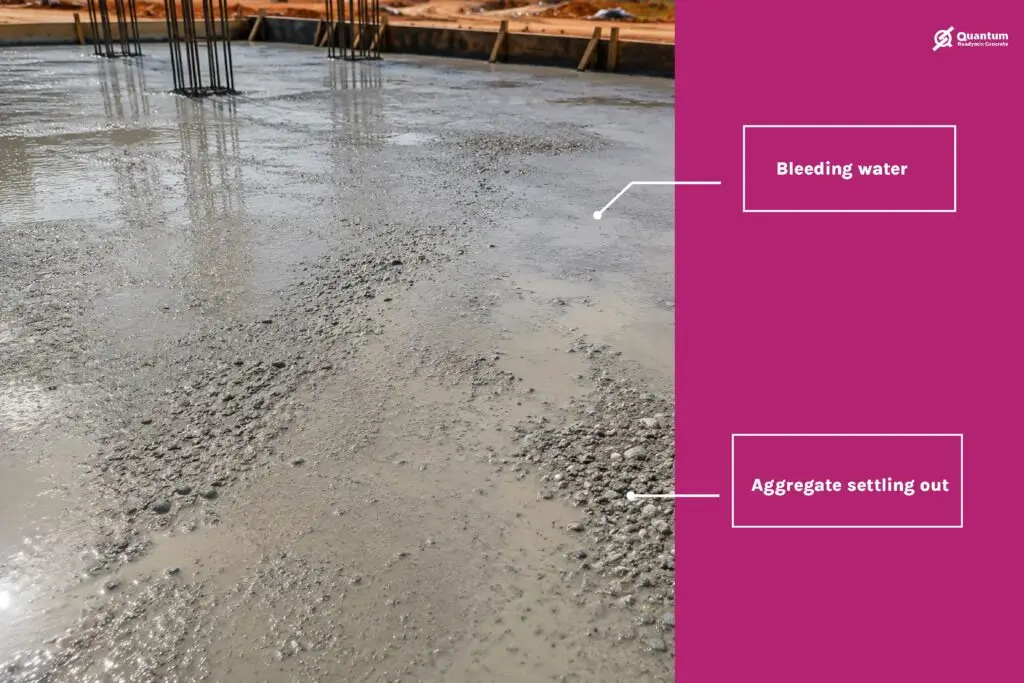
Too much water in concrete creates quality risk because it can reduce strength, increase variability and make later disputes harder to resolve.
Water may make concrete easier to place for a short period, but it changes the concrete that was supplied. If water is added without a record, everyone loses clarity later. The contractor sees a placing problem. The client sees a quality risk. The supplier sees a mix that may no longer match what left the plant.
Adding water can affect:
- compressive strength
- consistency
- surface quality
- durability
- shrinkage risk
- cube test interpretation
- responsibility between supplier and site
This does not mean water can never be adjusted. It means the decision must be controlled, authorised and documented.
The better solution is to reduce the need for water in the first place. If the site is ready, the truck does not stand unnecessarily, and the placing method suits the mix, there is less pressure to use water as a rescue tool.
What to check before water is added
Before water is added, the site team should check whether the problem is the concrete, the timing, the placing method or the site readiness.
| Site check | Why it matters |
|---|---|
| Confirm the specified slump | Prevents water being added when concrete is already within range |
| Check the expected concrete slump range | Standard mixes and pump mixes are not judged the same way |
| Check time since arrival | Workability reduces while the truck stands |
| Check temperature and site conditions | Warm or adverse conditions increase slump loss |
| Confirm access and placing route | Poor access can make acceptable concrete feel unworkable |
| Confirm labour and equipment readiness | Delays increase the pressure to add water |
| Confirm vibration and compaction plan | Proper compaction helps lower-slump concrete perform |
| Identify who can authorise water | Responsibility must be clear before the mix is changed |
| Record water on the delivery note | Protects both the site team and supplier later |
Expert site tip
The best time to protect slump is before the truck arrives. If the site is ready, the concrete can be placed while it is still within its intended workability range. If the site is not ready, water becomes a tempting fix for a planning problem.
H2: Why vibration still matters when slump is lower
Vibration helps concrete compact properly, especially when slump is lower than the placing team would like.
As slump reduces, concrete becomes harder to move and consolidate. If it is not vibrated properly, air can remain trapped inside the concrete and create weak areas or voids. Don’t’ underestimate vibration; unvibrated concrete containing as little as 5% air can reduce concrete strength by about 30%.
This does not mean vibration can solve every slump problem. It means site teams should not treat water as the only tool available. Prompt placing, proper compaction and correct vibration are part of the same quality decision.
Low workability can contribute to honeycombing if the concrete cannot flow and consolidate around reinforcement or into formwork. This article mentions that risk because it is part of Tip 12, but the deeper discussion belongs in the air-voids and compaction article.
When adding water is the wrong decision
Adding water is the wrong decision when the real problem is site delay, poor access, missing labour or unsuitable placing equipment.
Water can make concrete easier to move, but it cannot fix an unprepared site without changing the risk profile of the concrete. If the truck has stood too long, the team should not pretend the concrete is unchanged. If the site needs higher workability, the team should not treat an unrecorded water addition as the same thing as ordering the correct mix.
| If the problem is... | Better response |
|---|---|
| The truck has stood too long | Review timing, slump and risk before continuing |
| The concrete needs to be pumped | Order or confirm the correct pump mix |
| The concrete is within tolerance but difficult to place | Check access, labour, vibration and placing method |
| Water is genuinely required | Authorise it and record it on the delivery note |
The practical lesson is simple: do not use water to compensate for an unprepared site. If water is added, make it a controlled decision.
Questions site teams ask after a slump issue
Does a higher slump mean better concrete?
No. A higher slump means the concrete is more workable, but it does not automatically mean better concrete. If the higher slump is caused by excess water, strength and quality can be reduced.
Is adding water the same as ordering a pump mix?
No. A pump mix is designed for higher workability. Adding water on site changes the supplied concrete and can affect its performance.
Who should authorise water on site?
The manager or dually appointed person should authorise water addition before it happens. The decision should be recorded on the delivery note or docket because it affects responsibility if quality or strength is questioned later.
What should be checked if the concrete arrives too stiff?
Check the specified slump, time since arrival, weather conditions, placing method, site readiness and whether the mix is still within tolerance. A stiff appearance alone is not enough to justify uncontrolled water addition.
When should the site consider a different mix next time?
If the site repeatedly needs more workability because of access, pumping, reinforcement congestion or placing speed, the next order should be discussed before dispatch. It is better to order the correct workability than to correct the concrete with water on site.
One thing to remember
Concrete slump helps site teams understand workability, but it does not fix poor site preparation. The best way to avoid too much water in concrete is to prepare the site properly, place the concrete promptly, record any authorised water addition and compact the concrete correctly.
Looking for more practical concrete guidance? Browse Quantum’s Technical Tips library.