
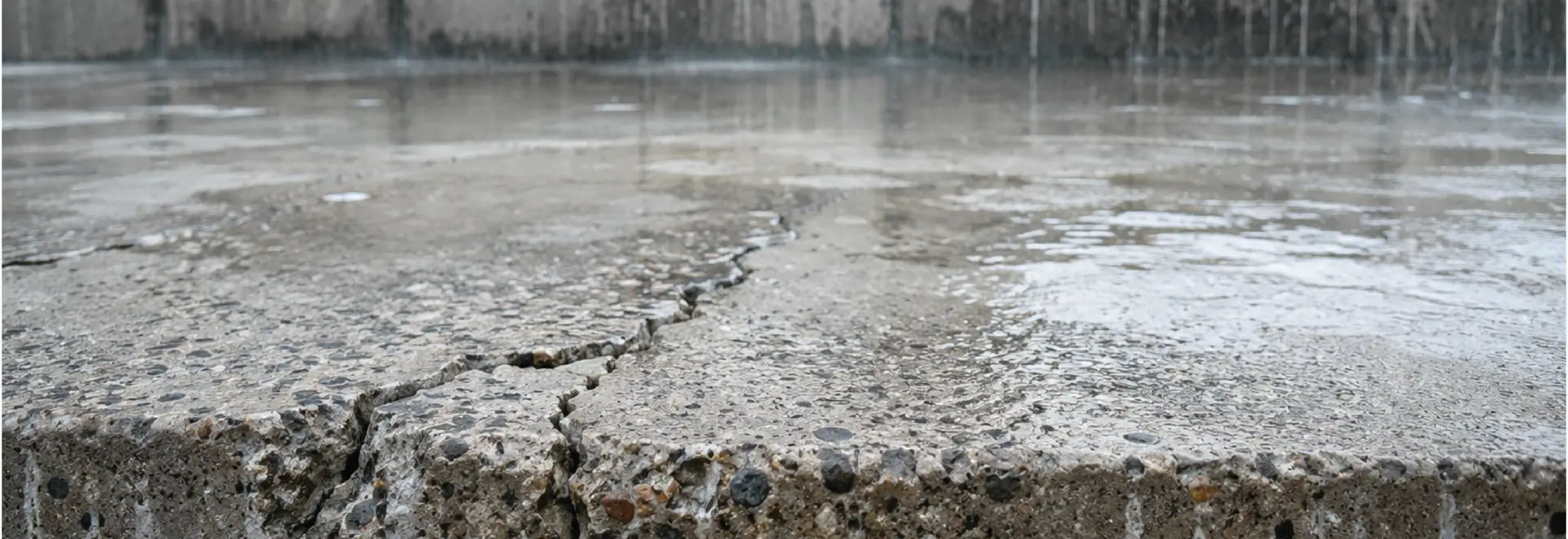






The water cement ratio in concrete affects strength, durability and shrinkage. Concrete needs water for workability and cement hydration, but extra water can reduce compressive strength and increase capillary pores. Good concrete depends on controlling water in the fresh mix and retaining enough moisture during curing.
What this guide covers
- Why water in concrete must be controlled
- How the water cement ratio in concrete affects strength
- Why extra water increases capillary pores and shrinkage risk
- Why curing is about moisture retention, not uncontrolled water addition
- How temperature affects strength gain during curing
- Practical water-control checks for site teams
Why does water in concrete need to be controlled?
Water in concrete is essential, but the amount of water must be controlled before and after placing.
Fresh concrete needs water for workability. Hardened concrete needs water for cement hydration. The problem starts when the mix contains more water than it was designed to use.
Extra water may make fresh concrete easier to place for a short time, but it changes the hardened concrete. As that excess water leaves the concrete, it can leave behind capillary pores. These pores reduce density, increase permeability and make the concrete more vulnerable to shrinkage and durability problems.
This is the practical balance:
| Water-control issue | What it affects | Site result |
|---|---|---|
| Too little workability | Placing and compaction | Concrete may be difficult to place and consolidate |
| Correct designed water content | Workability and strength | Concrete can be placed while still achieving design performance |
| Extra water above design | Strength and durability | More capillary pores, lower strength and higher shrinkage risk |
| Poor moisture retention after placing | Strength gain | Concrete may stop gaining strength too early |
The key is not simply “less water is better”. The correct message is: use the designed water content, place the concrete properly, and then retain moisture during curing.
How does extra water reduce concrete strength?
The water cement ratio in concrete controls how much water is present compared with cement in the mix.
When extra water is added after batching, the water-cement ratio increases. This is commonly called retempering. It may make the concrete more workable, but it can reduce compressive strength.
A practical example: adding 10 litres of water per cubic metre can reduce compressive strength by almost 10%.
Extra water also increases pore volume. In the source example, increasing the water-cement ratio from 0.5 to 0.6 can double the volume of capillary pores in the concrete. That matters because pores allow water and other substances to move more freely through the hardened concrete.
A higher concrete mix water ratio can lead to:
- Lower compressive strength
- Increased capillary pore volume
- Higher shrinkage potential
- Reduced durability
- Greater permeability
- Lower resistance to long-term deterioration
This is why added water is not only a slump or workability decision. It affects the hardened concrete long after the pour is complete.
Why does concrete still need moisture during curing?
Concrete needs moisture during curing because cement hydration continues while water is available.
This is where site teams often confuse two different issues:
- Extra water added into the fresh mix can reduce strength.
- Moisture retained after placing helps concrete gain strength.

Water reacts with cement and supports the formation of calcium silicate hydrate crystals. These crystals are responsible for much of the setting and strength gain in concrete. If the concrete dries out too soon, crystal growth slows or stops, and the concrete may not reach its intended strength.
Concrete is normally designed around a 28-day strength. If it loses moisture too early during that period, strength development can be reduced even when the original mix was correct.
Good moisture retention helps improve:
- Design strength achievement
- Abrasion resistance
- Surface durability
- Resistance to dusting
- Reduced random cracking risk
- Lower carbonation rate
- Better protection of reinforcing steel
- Longer service life
Curing is therefore not about adding water to the mix. It is about keeping the concrete moist enough for hydration to continue after the initial set.
How much can curing affect strength?
Curing can make the difference between concrete reaching its design strength and falling well short of it.
The Tip 7 curing graph compares concrete kept continuously wet, concrete given three days of moist curing, and concrete given no moist curing. The practical message is clear: concrete that is allowed to dry too early does not gain strength properly.
In the source example:
| Curing condition | Practical strength outcome |
|---|---|
| Continuously wet for 28 days | Best chance of achieving the 28-day design strength |
| Three days of moist curing | Better than no curing, but still below continuous curing |
| No moist curing | 28-day strength can be severely reduced |
| Early drying | Hydration can slow or stop before full strength develops |
In the example, concrete with no moist curing achieved only about two thirds of its design strength at 28 days. With three days of effective curing, strength increased to over 80%.
The first seven days are especially important, but curing should continue for as long as practical.
How does temperature affect strength gain?
Temperature affects how quickly concrete gains strength during curing.
Concrete needs both moisture and suitable temperature to gain strength properly. Low temperatures slow the hydration process. This means concrete placed in winter can take much longer to reach strength than concrete placed in warmer conditions.
The Tip 7 source notes that concrete cured at 5°C achieved about half of the 3-day strength and about 80% of the 28-day strength achieved by concrete cured at 23°C in the example shown.
This does not mean cold concrete has failed. It means strength gain is slower and expectations must be adjusted.
Concrete containing fly ash may also show lower early strengths at all temperatures, even though it can continue gaining strength over time.
Practical water-control workflow for site teams
Good water control means managing the mix before placing, protecting it during placing, and retaining moisture after finishing.
Use this workflow on site:
| Stage | What to check | Why it matters |
|---|---|---|
| Before the pour | Confirm the concrete is suitable for the placing method | Reduces pressure to add water later |
| On delivery | Check workability before making changes | Avoids unnecessary retempering |
| During placing | Do not use water to compensate for poor access or delays | Protects the designed mix performance |
| If water is authorised | Record it clearly on the delivery note or docket | Keeps responsibility and quality records clear |
| Stage | What to check | Why it matters |
|---|---|---|
| After finishing | Start curing as soon as practical | Helps retain moisture for strength gain |
| During early curing | Protect concrete from rapid drying | Reduces strength loss and shrinkage risk |
| In cold conditions | Allow for slower strength gain | Prevents unrealistic early-strength expectations |
Common water-control mistakes to avoid
- Adding water because the site is not ready
- Confusing slump recovery with strength protection
- Letting concrete dry before curing starts
- Assuming concrete gains strength at the same rate in all seasons
- Treating curing as optional once finishing is complete
Expert site tip
Do not confuse water needed for hydration with extra water added for convenience. Concrete needs moisture to cure, but uncontrolled water added above the designed mix can reduce strength, increase pores and make the hardened concrete less durable.
Quick answers to common water-cement questions
Is water-cement ratio the same as slump?
No. Slump measures fresh concrete workability, while the water-cement ratio describes the relationship between water and cement in the mix. Slump is a site workability measure. Water-cement ratio is a strength and durability factor.
Why can water be good for curing but bad for the mix?
Water retained after placing helps cement hydration continue. Extra water added into the fresh mix increases the water-cement ratio and can reduce the strength and durability of the hardened concrete.
What happens if concrete dries out too early?
If concrete dries out too early, hydration slows or stops. The concrete may then fail to reach its intended strength, even if the original mix design was correct.
Does cold weather change the water-cement ratio?
No. Cold weather does not change the water-cement ratio, but it slows the rate at which concrete gains strength. This is why winter strength development can be slower than expected.
Can extra water increase cracking risk?
Yes. Extra water can increase shrinkage potential by increasing pore volume and moisture movement in the hardened concrete. Crack type and prevention are covered in the concrete cracks article.
One thing to remember
The water cement ratio in concrete controls much more than fresh workability. Extra water can reduce strength and increase capillary pores, while good moisture retention helps concrete keep gaining strength. Strong, durable concrete depends on controlling water before, during and after placing.
Looking for more practical concrete guidance? Browse Quantum’s Technical Tips library.